An IPO, De-SPAC, reverse takeover and direct listing can all lead to the same exchange, but serve different purposes. The right route depends on your company's needs, not simply which option looks best.
Originally published on Welsbach SPACtacular Insights (Substack)
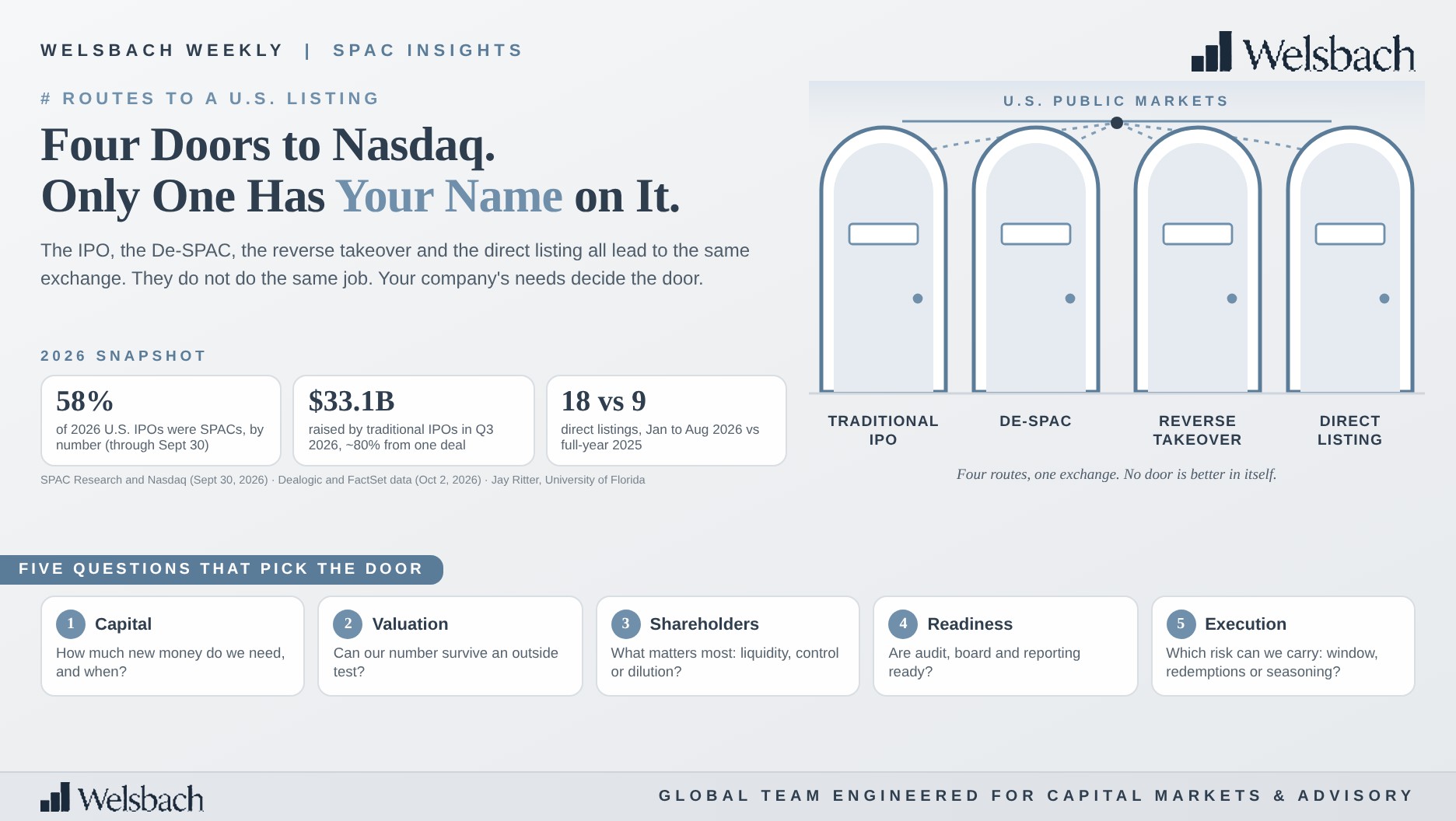
| 2026 Snapshot | Value |
|---|---|
| Share of 2026 U.S. IPOs that were SPACs, by number (through Sept 30) | 58% |
| Raised by traditional IPOs in Q3 2026 (~80% from one deal) | $33.1B |
| Direct listings, Jan to Aug 2026 vs full-year 2025 | 18 vs 9 |
| The bottom line | Eligibility gets you to the door. Readiness and fit get you through it. |
"Should we IPO or do a SPAC?" is the question founders ask most often when they start thinking about a U.S. listing. It is also the wrong place to start. The four routes to Nasdaq end at the same exchange, but they raise different amounts of money, set the price differently, fail for different reasons, and ask different things of the company. The right route is the one that matches what the company needs and what it can be ready for.
The Doors Are All Open. That Is the Problem
2026 has opened every route at once. Through September, 152 SPAC IPOs priced, 58% of all U.S. IPOs by number (SPAC Research and Nasdaq, as of Sept 30, 2026).
Traditional IPOs raised $33.1 billion in the third quarter alone. SK Hynix's $26.5 billion listing accounted for roughly 80% of that, and Holtec, Bamboo and Oura postponed their September listings as rates rose (Dealogic and FactSet data, as of Oct 2, 2026).
Direct listings have multiplied: 18 in the first eight months of 2026, against nine in all of 2025, although most since 2022 have been microcaps (Jay Ritter, University of Florida). Reverse takeovers remain the quiet fourth door. No consolidated U.S. dataset tracks them.
When every door is open, founders tend to pick the one with the most noise around it. That is how companies end up in structures built for someone else.
Same Exchange, Different Deals
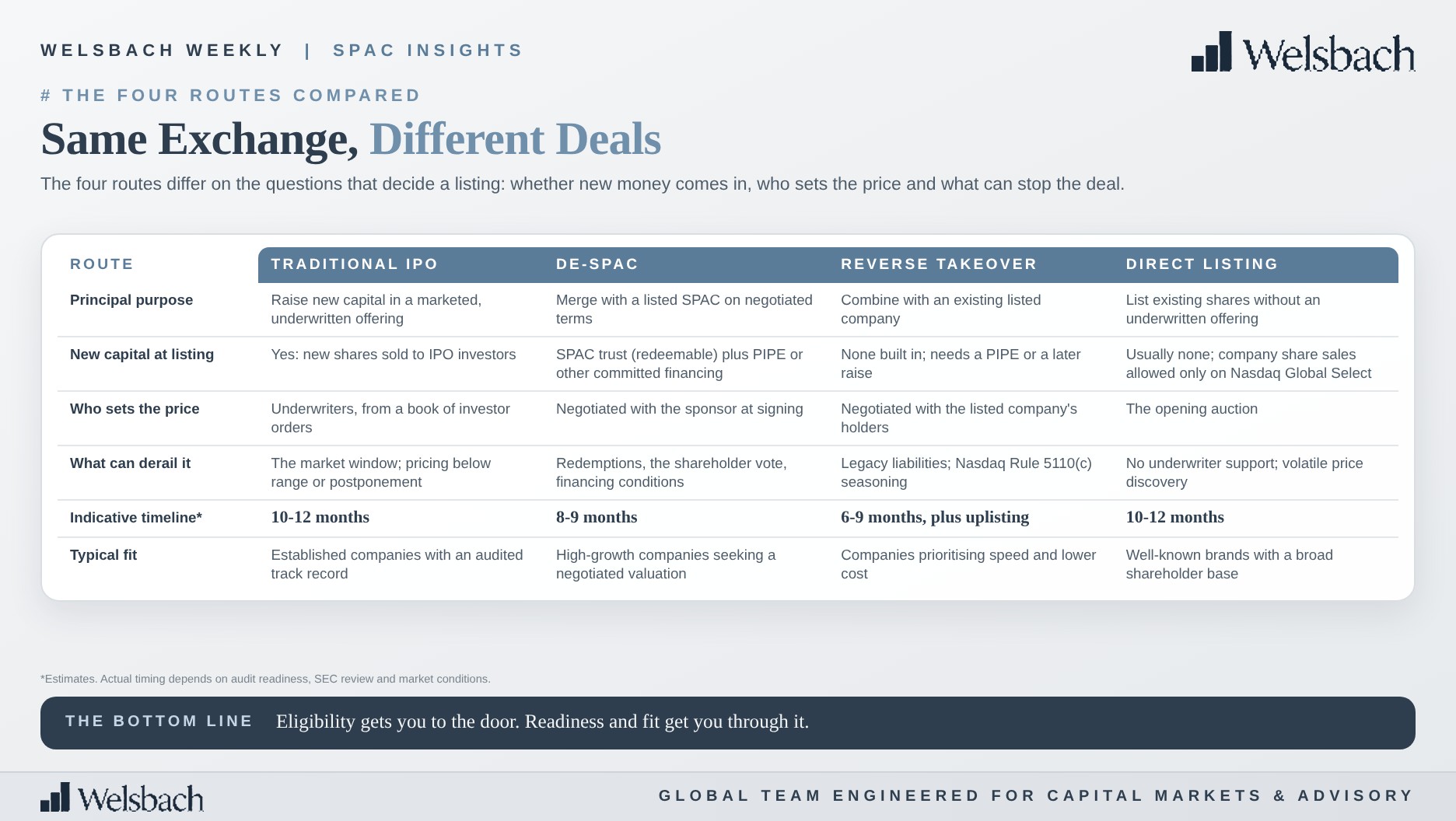
The four routes are not variations on one product. They differ on the three questions that decide a listing: whether new money comes in, who sets the price, and what can stop the deal.
The IPO is the only route designed from the start to raise new capital in a marketed process. That is its strength and its constraint. On the Nasdaq Capital Market, an IPO company must create at least $15 million of unrestricted publicly held shares from the offering itself (SEC Release 34-105494, May 14, 2026), so the raise has to be large enough to build a real public float. The book of investor orders is also an honest verdict on valuation, delivered on the investors' schedule.
The De-SPAC replaces the book with a negotiation. The value is agreed with one sponsor, which suits companies whose story needs explaining. But trust cash is redeemable, not committed: the 20 most recent closed De-SPACs saw a median 96.2% of trust shares redeemed (SPAC Insider and FactSet data, as of Oct 2, 2026). Since July 2024, SEC rules also treat the target as a co-registrant on the merger registration statement and remove the safe harbour for forward-looking statements (SEC, 2024). The disclosure burden now looks much like an IPO's.
The reverse takeover is the fastest to complete and the slowest to finish. Merging into an existing listed company is not the same as being admitted to Nasdaq. Under Nasdaq Rule 5110(c), a company formed by reverse merger must generally trade for a year on the OTC market or another exchange and hold the initial listing price for 30 of the previous 60 trading days. It must also file a full year of audited results before it can apply, unless it completes a firm-commitment underwritten offering of at least $40 million. The shell also brings its history with it.
The direct listing gives existing holders liquidity and lets the market set the price in an opening auction, with no underwriting spread. It usually raises no new money. Since May 2021, a company can sell its own shares in the auction, but only on the Nasdaq Global Select Market and only with at least $110 million of unrestricted publicly held shares, or $100 million with $110 million of stockholders' equity (Wilson Sonsini).
 View full size
| Route | Traditional IPO | De-SPAC | Reverse Takeover | Direct Listing |
|---|---|---|---|---|
| Principal purpose | Raise new capital in a marketed, underwritten offering | Merge with a listed SPAC on negotiated terms | Combine with an existing listed company | List existing shares without an underwritten offering |
| New capital at listing | Yes: new shares sold to IPO investors | SPAC trust (redeemable) plus PIPE or other committed financing | None built in; needs a PIPE or a later raise | Usually none; company share sales allowed only on Nasdaq Global Select |
| Who sets the price | Underwriters, from a book of investor orders | Negotiated with the sponsor at signing | Negotiated with the listed company's holders | The opening auction |
| What can derail it | The market window; pricing below range or postponement | Redemptions, the shareholder vote, financing conditions | Legacy liabilities; Nasdaq Rule 5110(c) seasoning | No underwriter support; volatile price discovery |
| Indicative timeline* | 10-12 months | 8-9 months | 6-9 months, plus uplisting | 10-12 months |
| Typical fit | Established companies with an audited track record | High-growth companies seeking a negotiated valuation | Companies prioritising speed and lower cost | Well-known brands with a broad shareholder base |
Four routes lead to Nasdaq. They raise different money, set the price differently and fail for different reasons. Choose by need, not by fashion.
The Wrong Door Still Opens
The real risk is not picking a route a company cannot complete. It is picking one it can complete but should not have chosen. Three mismatches recur.
Choosing liquidity when you need capital. A direct listing or a reverse takeover can make a company public without funding its plan. If the business needs growth capital, listing without it means raising later from a weaker position, priced off a thin and volatile market.
Choosing a negotiation when you need validation. A negotiated value can be higher than a book of orders would bear, and the market reprices it after closing. The median recent De-SPAC traded at $3.55 against its $10 reference in early October (SPAC Insider and FactSet data). The IPO is no guarantee either: the last 20 traditional IPOs were trading at a median 0.3% below their offer price on the same date. Each route has its own way of testing a valuation.
Choosing speed when you are not ready. A fast route does not shorten the audit, the governance build or the reporting obligations. It only changes the moment the gaps become public.
Eligibility is also not the decision. Meeting Nasdaq's quantitative standards gets a company to the door. It does not tell the board whether becoming public is the right financing strategy, or the right moment.
Start With the Need, Not the Door
Companies that choose well answer five questions, in this order, before they speak to a banker or a sponsor.
- How much new money do we need, and when? A large primary raise points to an IPO or a well-financed De-SPAC. If no new money is needed, a direct listing becomes credible.
- Can our valuation survive an outside test? If a book of orders would value the company near your own number, an IPO's price discovery works for you. If the value rests on a roadmap that needs explaining, a negotiated route may fit better, provided committed investors back the number.
- What do existing shareholders want? Liquidity, control and dilution weigh differently in each route.
- What can we have ready? PCAOB-audited financials, a public-company board and reporting processes are needed on every route that ends at Nasdaq. A faster route does not make any of them optional.
- How much execution risk can we carry? A market window, a redemption line, a seasoning period: every route has a point where it can fail.
The answers usually narrow four doors to one, occasionally two. That is the purpose of the exercise.
Welsbach - Reading the Floor Plan
Welsbach advises growth companies valued at roughly US$150 million to US$4 billion on U.S. capital-markets strategy across all four routes: route selection, listing readiness, financing and execution. Our route-matching process scores a company against the IPO, SPAC, reverse-takeover and direct-listing paths. A senior team member then gives a plain-language recommendation on whether to proceed, by which route, and what comes next. In our view, that assessment belongs 12 to 24 months before a planned listing or financing, while every door is still open, not after one has been chosen by default.
"Where's this Number From?"
Four words that can unravel a pitch the night before it goes out.
Watch Brexy's Research & Market Intelligence AI agent team turn a single request into a sourced, review-ready intelligence brief.
How the Workflow Runs:
- Scope: the lead agent breaks your question into what the brief needs to answer
- Monitor: a monitoring agent pulls the latest news, filings and disclosures, and flags anything touching a live deal
- Research: a sector agent runs the deep dive: competitive landscape, comps and precedent transactions
- Verify: a verification agent checks every figure against its primary source and dates it
- Brief: the lead assembles one brief, ranked by what matters most for the decision
- You Approve: nothing goes further without your sign-off
One rule runs through all of it: no figure without a source and an as-of date. If a claim can't be verified, it's flagged for you, not quietly dropped.
Give it a try with one month free: https://studio.brexy.ai/
Your Name Is on One Door
Nasdaq does not reward a route. It admits companies that meet its standards and leaves the market to judge them afterwards. The IPO, the De-SPAC, the reverse takeover and the direct listing are tools for different jobs. Founders who start from the door they like have already let the structure make the decision for them. Founders who start from what the company needs usually find that only one door was ever really theirs.
Exploring growth capital or a U.S. listing? Partner with the Welsbach team to make it happen.
- Reach Us: Click Here
- Website: https://welsbach.group/
- Email: contact@welsbach.sg
Download
Take this edition with you
Register once to download this Welsbach Weekly edition as a branded PDF, including all charts and exhibits.