In the third quarter, most of the money that committed to De-SPACs arrived as convertible paper, not common stock at the deal price. The market priced the difference.
Originally published on Welsbach SPACtacular Insights (Substack)
The article teaches a founder that the form of the cheque matters more than its size, and that a strong common-stock book has to be built before announcement with the right investors. That is placement and positioning work. A reader who accepts the thesis concludes privately: we need investors who will buy our stock at $10, and we need to find them early. That is the inbound.
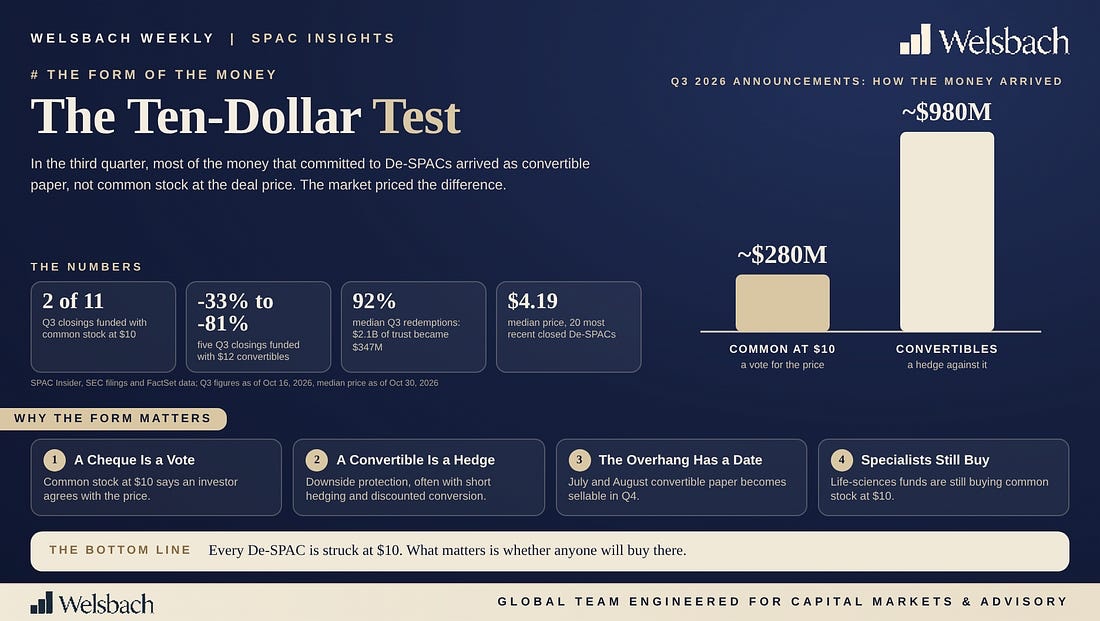
Eleven De-SPAC mergers completed in the third quarter of 2026. Only two were funded with investors buying common stock at $10, the price every deal is struck at. Five were funded with convertibles carrying a $12 conversion price. By mid-October, those five traded between 33% and 81% below $10 (industry analysis of SPAC Insider data, SEC filings and FactSet, prices as of Oct 16, 2026).
Across the 30 deals announced in the quarter, the gap was wider. Committed common equity came to about $280 million. Convertibles came to about $980 million. The money did not stop committing to De-SPACs. It changed shape, and the shape is now the signal.
The Money Changed Shape
Two forces drove the change. The first was the market. The Federal Reserve raised rates on September 16 for the first time this year, the 10-year Treasury reached 5.3%, and small-cap growth stocks fell. The deep-tech premium went with them. Horizon Quantum traded 138% above $10 in July and 25% above in mid-October. Xanadu went from 12% above to 70% below. In July, seven of the year’s first-half De-SPACs traded above $10; by mid-October, three did.
The second force was redemptions. Median redemptions on third-quarter closings were 92%, turning $2.1 billion of trust into $347 million. With so little trust cash surviving, committed financing became the deal. And investors asked to commit into a falling tape preferred paper that protected them.
The pending pipeline tells the same story. Of the 30 deals announced in the third quarter, 23 traded within 2% of the cash in their SPAC’s trust by mid-October, and none more than 1% above it. Agility Robotics’ pending combination traded 50% above its trust cash in July and 4% above in October. The market is no longer paying in advance for announcements; it is waiting to see what the financing looks like.
A Cheque Is a Vote. A Convertible Is a Hedge.
The two instruments say different things.
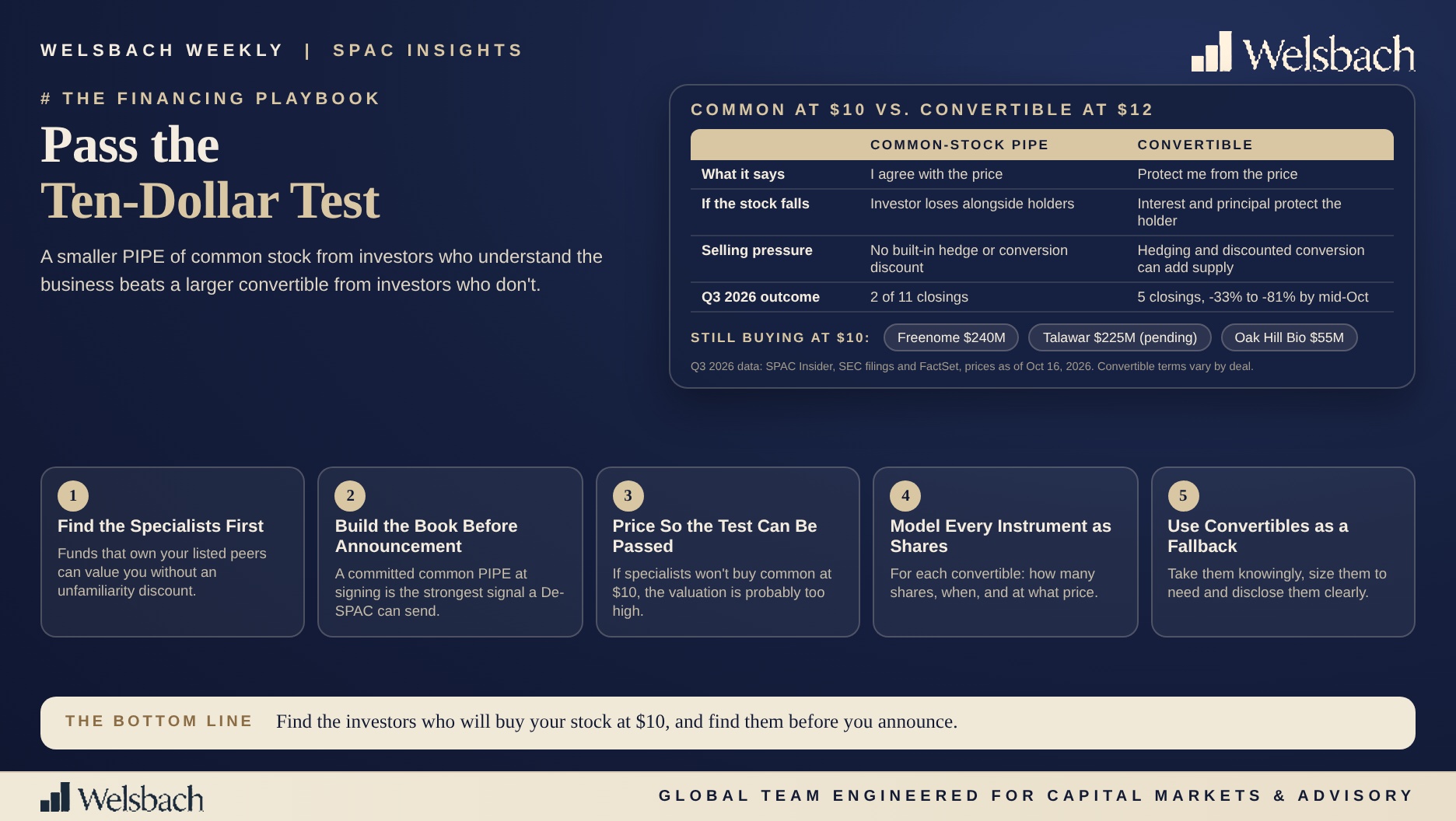
A common-stock PIPE at $10 is the simplest statement an investor can make: I will buy this company at the price you agreed. If the stock falls, the investor loses money alongside everyone else. That is why it validates the valuation. As we wrote in Raise for the Plan, it is the nearest thing a De-SPAC has to a book.
A convertible is a loan that can turn into equity. The holder gets interest and its money back if the stock disappoints, and shares if it rises above the conversion price. A $12 conversion price sounds generous, since it is above the deal price. But the headline is rarely the whole story. Convertible holders commonly hedge by selling the stock short, and depending on the terms, notes may be repaid or converted in shares priced at a discount to the market. Every one of those mechanics puts selling pressure on a thinly traded stock. The investor is not voting for the price. It is protecting itself against the price.
The market reads that difference. A deal funded with $280 million of common stock at $10 tells investors that someone sophisticated agreed with the valuation. A deal funded with convertibles tells them someone sophisticated wanted protection from it.
Correlation is not proof. Eleven closings in a falling market are a small sample, and weaker companies may have had no choice but convertibles. But the pattern is consistent with how these instruments work, and it is too sharp to ignore.
The Overhang Arrives on Schedule
There is a second problem, and it has a date. Convertible paper issued at the July and August closings becomes freely sellable in the fourth quarter, once the shares behind it are registered. A company that closed on convertible financing faces that supply arriving on a timetable, whatever its operating results.
Founders often treat financing terms as a closing issue. They are a first-year issue. Every convertible, warrant and forward contract signed to get a deal over the line becomes shares that can reach the market later. The cost of today’s easier money is paid in next year’s share price.
The latest data shows the pressure. The 20 most recent closed De-SPACs traded at a median $4.19 at the end of October, with median redemptions of 96.2% (SPAC Insider and FactSet data, as of Oct 30, 2026).
Who Is Still Buying at $10
One sector is passing the test. In life sciences, specialist investors are still buying common stock at the deal price. Freenome closed in July with a $240 million common-stock PIPE at $10 from crossover funds and only 24.9% redemptions. It traded at $12.48 at the end of October. Talawar Therapeutics has a $225 million committed common PIPE pending, and Oak Hill Bio announced a $55 million PIPE from a 12-name biotech syndicate buying common stock at $10. October added two more biotech combinations with sizeable PIPEs: Corxel at $300 million and TriGemX Bio at $160 million.
The pattern is not about biotech’s prospects. It is about investor type. Life sciences has a deep bench of crossover and specialist funds that can value a pipeline and are prepared to own it. Deep tech has fewer such investors, and in a falling market the generalists asked for protection instead.
That is the real lesson for every sector: the ten-dollar test is passed by finding the investors who understand your business well enough to buy it outright.
Pass the Ten-Dollar Test
Founders who want common-stock money at the deal price usually do five things.
 View full size
- Find the specialists first. Identify the funds that already own listed peers and can value your business without a discount for unfamiliarity. They are the buyers of common stock
- Build the book before announcement. A committed common PIPE signed at announcement is the strongest signal a De-SPAC can send. Chasing it after the market has seen the deal is harder and costlier
- Price so the test can be passed. If specialists will not buy common at $10, the valuation is probably too high. Lowering it is cheaper than funding it with paper
- Model every instrument as future shares. For any convertible or structured financing, work out how many shares could reach the market, when and at what price. That is the true cost
- Treat a convertible as a fallback, not a plan. Sometimes it is the only money available. Take it knowingly, size it to need, and disclose it clearly
Capital Is Not the Problem. Finding the Right Buyers Is.
Companies seeking U.S. public-market capital often face the same problem: when the right institutional investors are not at the table, common equity gives way to expensive, dilutive financing.
Welsbach helps change that equation. We identify specialist and crossover investors already invested in a company’s listed peers, engage them early to establish valuation expectations and build demand for common equity before a transaction is announced. Where structured capital is necessary, we quantify its full dilution and share-cost implications so management can make informed decisions.
For cross-border businesses targeting U.S. markets, we bring together the investor access, capital markets strategy, transaction execution and institutional readiness required to bridge the gap between a compelling business and an investable public-market opportunity. The objective is simple: attract the right shareholders, secure better-quality capital and build a stronger foundation for life as a listed company.
Need comps before a call? Building a buyer list? Reviewing a CIM?
This time, we have something new to share: Brexy Agent Studio is live, and your first month is free.
You can put AI agent teams to work on the first pass, so you spend less time gathering information and more time on the work that needs your judgment. Inside the studio, you’ll find specialist teams for financial analysis and valuation, research and market intelligence, M&A, and coverage and origination. And that’s just the start.
You can explore more teams in the studio and create your own agent teams based on your workflows and requirements.
Whether you want help with a specific task or want to build a team around the way you work, you can shape Brexy to fit your needs.
You may explore the studio, and see what you can put to work.
A $10 Valuation Means Nothing Without Buyers
A $10 valuation is easy to negotiate. Finding investors willing to pay $10 is the real test. Every De-SPAC starts with a $10 reference price, but that number means little without genuine investor demand behind it. In Q3 2026, committed capital increasingly favoured downside protection over outright equity participation, exposing the gap between headline valuations and actual market conviction. The distinction matters: a smaller PIPE from investors who understand the business and are willing to own common stock can be far more valuable than a larger convertible loaded with dilution and downside protections. The real measure of a successful De-SPAC is not the valuation announced, but whether the market is willing to stand behind it.
Exploring growth capital or a U.S. listing? Partner with the Welsbach team to make it happen.
Reach Us: Click Here
Website: https://welsbach.group/
Email: contact@welsbach.sg
Download
Take this edition with you
Register once to download this Welsbach Weekly edition as a branded PDF, including all charts and exhibits.