What 2026's De-SPAC disclosures reveal about the cost of reaching the U.S. public markets, and what they leave out.
Originally published on Welsbach SPACtacular Insights (Substack)
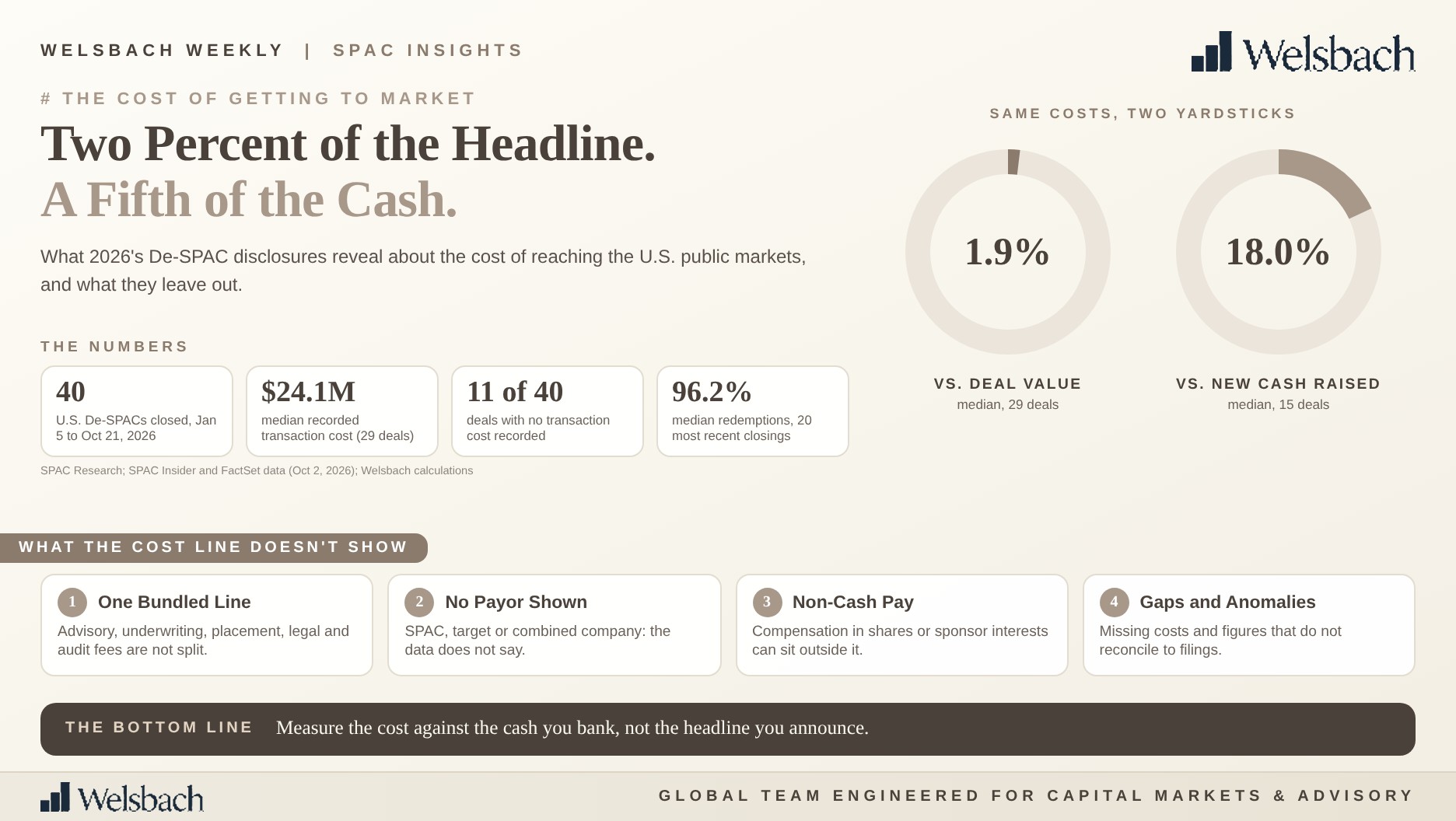
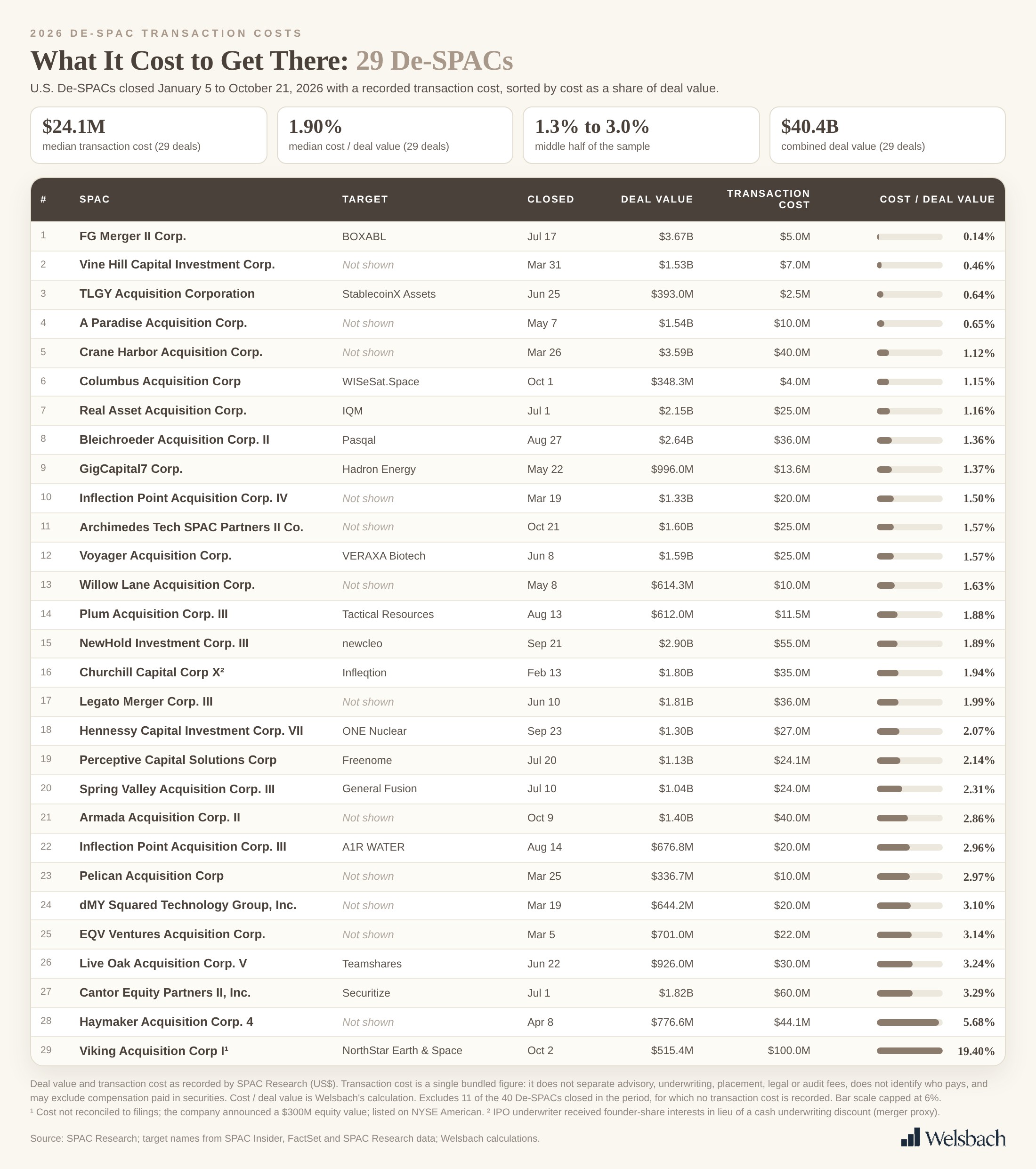
Forty De-SPAC mergers closed in the U.S. between January 5 and October 21 this year. For 29 of them, records show a deal value and a transaction cost. Put the two side by side and going public looks cheap: the median cost was $24.1 million, or 1.9% of deal value.
Now set the same costs against the new money those deals actually brought in. For the 15 transactions where PIPE and other committed financing are disclosed in the data, the median transaction cost equalled 18% of that capital; in aggregate, nearly a fifth. Same dollars, different denominator, and a very different conversation in the boardroom.
2% - The Flattering Yardstick
Start with what the data shows. Across the 29 deals with both figures, recorded transaction costs ranged from $2.5 million to $100 million, with a median of $24.1 million. As a share of deal value, the middle half of the sample sat between 1.3% and 3.0%. Four deals came in under 1%; six were above 3%. In aggregate, the 29 deals recorded $782 million of costs against $40.4 billion of deal value, or 1.9%.
The trouble is the yardstick. Deal value counts the shares a company's existing owners roll into the public entity, which no adviser raised and no new investor paid for. A $1.5 billion deal value is mostly private shareholders exchanging one kind of paper for another. Measured against that, almost any cost looks small.
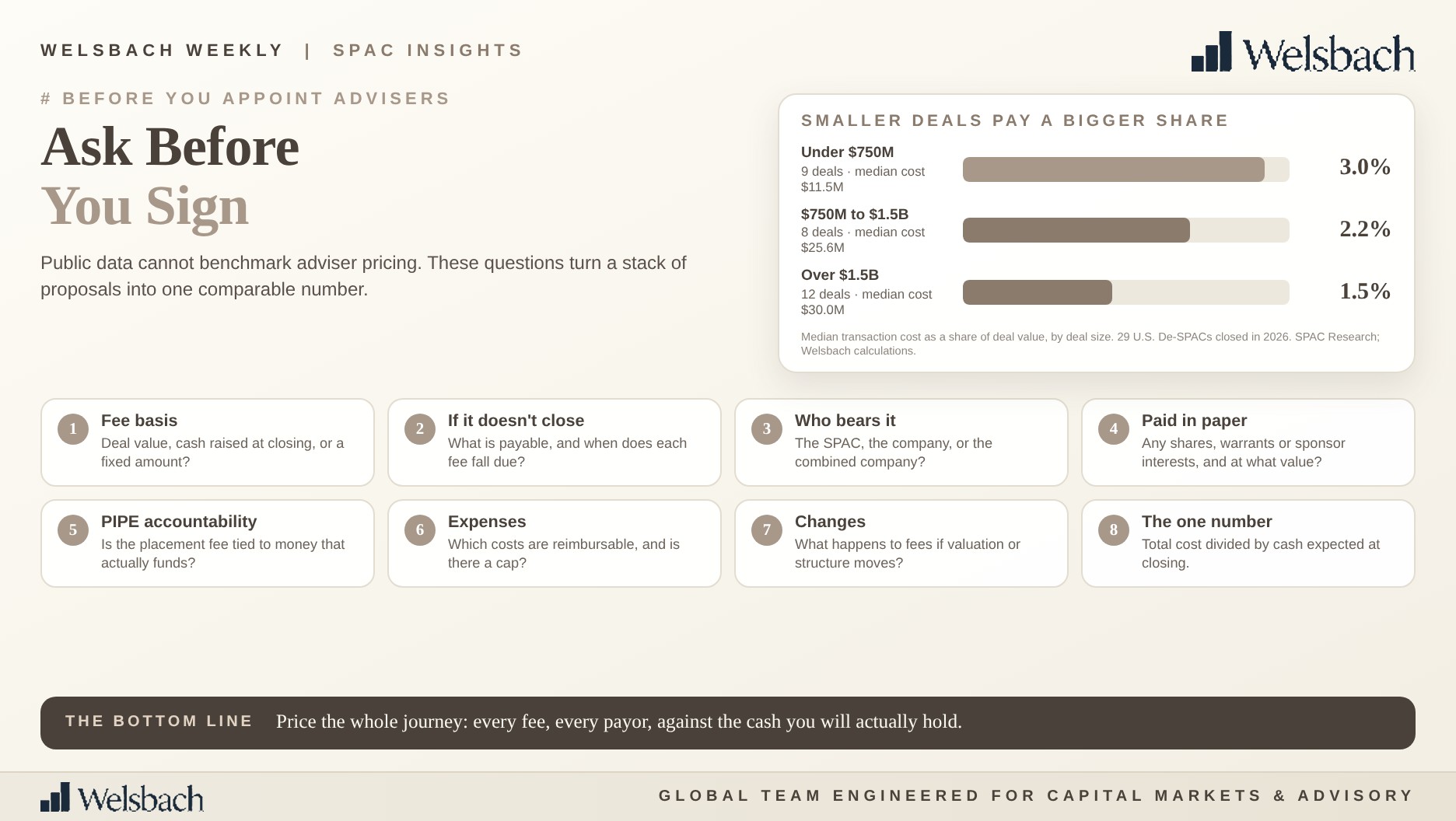
Size matters too. The costs behave like fixed costs. For deals valued under $750 million, the median cost was 3.0% of deal value (nine deals, median cost $11.5 million). Between $750 million and $1.5 billion it fell to 2.2% (eight deals), and above $1.5 billion to 1.5% (12 deals, median cost $30 million). The dollar bill rises with size; the percentage falls. Smaller companies pay roughly twice the share.
A Fifth of the Cash
The more useful question for a founder is what the listing costs per dollar the company actually banks. In 2026, that dollar rarely comes from the trust. Across the 20 most recent closings, a median 96.2% of trust shares were redeemed (SPAC Insider and FactSet data, as of October 2, 2026). The cash comes from the PIPE and other committed financing.
Measured against that capital, the picture changes. Freenome's recorded cost of $24.1 million equalled 10% of its $240 million PIPE. General Fusion's $24 million was 22% of a $108 million PIPE. ONE Nuclear's $27 million was 51% of $53 million in alternative financing. Pasqal's $36 million equalled 14% of its $250 million PIPE; Securitize's $60 million was 22% of $275 million in PIPE and alternative financing. StablecoinX sat at the other end: $2.5 million against $363 million, under 1%. Across the 15 deals, the median was 18.0%, and the aggregate 19.6%.
That ratio is a lens, not a fee rate. It excludes trust cash that survived redemptions, so where holders stayed, as at Freenome, which kept about three-quarters of its trust, the true cost per dollar is lower. But for most deals this year the trust delivered little, and the ratio is close to what management actually experiences.
 View full size
One Line, No Breakdown
Here is what the public data cannot tell you. Generally sources record one cost figure per deal. It does not separate financial-adviser fees from deferred underwriting commissions, placement fees, legal or audit costs, and it does not show whether the SPAC, the target or the combined company bears them. Deferred underwriting commissions, typically agreed at the SPAC's own IPO and payable when the merger closes, can sit inside the figure without the target ever having negotiated them. Eleven of the 40 deals have no recorded cost at all.
Compensation paid in securities can sit outside any cash figure. Churchill Capital Corp X's merger proxy for Infleqtion discloses that its IPO underwriter received sponsor interests in 360,000 founder shares "as upfront underwriting compensation in lieu of a cash underwriting discount" (SEC filing). A cash cost line cannot capture that.
The data has rough edges too. The highest ratio in the sample, Viking Acquisition Corp I's combination with NorthStar Earth & Space, shows $100 million of cost on a $515.4 million deal value. NorthStar announced the transaction at a $300 million equity value (company announcement), and we could not reconcile the cost figure to the filings we reviewed. That is why medians matter: remove the deal and the median barely moves.
The conclusion is uncomfortable but useful. Adviser pricing cannot be benchmarked from public numbers. The comparison has to be built deal by deal, from engagement letters.
Where Founders Get It Wrong
Founders usually see fee proposals one at a time: a financial adviser's success fee, a placement agent's percentage of the PIPE, legal and audit estimates, and deferred underwriting the SPAC already owes. Each looks reasonable against a large headline. Few founders add them together against the cash they expect to hold at closing, or ask which costs fall due whether or not the deal closes. Take a hypothetical company merging at a $1 billion deal value and raising $100 million. A $20 million cost bill is 2% of the headline and 20% of the cash.
That matters more this year than most. Around 36% of De-SPACs that closed in the first half of 2026 raised no new outside financing (Foley & Lardner, October 2026). When costs scale with a headline but cash does not arrive, the bill falls on a company that raised little. And the most expensive outcome is a deal that does not close at all: legal, audit and management time spent, and no listing to show for it.
Ask Before You Sign
These are not standard contract terms. They are the diligence questions that turn a stack of proposals into one comparable number.
 View full size
- What is each fee based on? Deal value, cash raised at closing, or a fixed amount?
- What is payable if the deal does not close, and when does each fee fall due?
- Who bears which cost: the SPAC, the company, or the combined company after closing?
- Is anything paid in shares, warrants or sponsor interests, and at what value?
- Who is responsible for raising the PIPE, and is that fee tied to money that actually funds?
- Which expenses are reimbursable, and is there a cap?
- What happens to fees if the valuation or structure changes before closing?
Pricing the Whole Journey
On one side sits the growth company. On the other sits the U.S. capital-markets ecosystem: sponsors, underwriters, PIPE investors, PCAOB auditors, securities lawyers and the exchange, each with its own engagement letter. Welsbach works at that intersection, and fee clarity is part of making a transaction executable.
The work starts before costs are incurred. We assess whether a U.S. listing fits the company, which route suits it and whether the business is ready, so management does not commit to a process it cannot finish. We then map the workstreams every listing needs, from audit and counsel to placement and investor relations, so roles do not overlap and gaps do not surface late. Finally, we put the total cost against the cash the company can realistically expect at closing, not against the headline. That gives management a single number for the economics of the whole transaction, and a clear view of who is accountable for delivering it.
Dear Investment Bankers,
Let Brexy Agent Studio Find Your Next Mandate
You don't need to watch every company yourself. You've got a team for that.
With Brexy Agent Studio, specialized AI agents work together to identify potential opportunities, track market signals, and support deal sourcing.
Meet your team:
- Research Agent: Scans 1,000+ companies across filings, news, and hiring data.
- Coverage Agent: Tracks developments and signals that could indicate potential deal activity.
- Deal Sourcing Agent: Ranks potential opportunities and brings relevant findings together for review.
And that's just one workflow.
From comps, valuation, and pitchbooks to due diligence, investment memos, ECM, DCM, and M&A execution, explore 100+ specialized agents or build your own agent teams.
Your next mandate deserves a smarter starting point.
Brexy Agent Studio, Give it a Try, FREE for 30 Days.
Price It Per Dollar Raised
A fee measured against deal value tells you what an adviser earns. A cost measured against the cash you bank tells you what the listing costs you. In 2026 those two numbers sit an order of magnitude apart.
For many businesses, a De-SPAC is not simply an alternative to an IPO; it may be the route that makes a U.S. public listing possible in the first place. Getting there requires capital, advisers, legal and audit work, investor commitments and management's own financial commitment to the process. Founders must be prepared to put skin in the game. The question is not whether the process is expensive, but whether the capital raised and the public-market platform created justify the investment.
The closing is only the beginning. Once listed, a company that delivers on its business plan and builds market credibility has the opportunity to raise additional capital against its public-market valuation. The initial transaction costs are largely a one-off investment in reaching that position; subsequent capital raises can be undertaken as the business grows and its funding needs evolve.
The lesson for founders is to understand the full cost of the journey, assess what capital will actually reach the business and choose advisers capable of helping deliver the financing and complete the transaction. A lower fee means little if the capital never arrives or the company never gets listed. The real measure of value is not just what the transaction costs, but what it enables the company to achieve afterwards.
Exploring growth capital or a U.S. listing? Partner with the Welsbach team to make it happen.
- Reach Us: Click Here
- Website: https://welsbach.group/
- Email: contact@welsbach.sg
Download
Take this edition with you
Register once to download this Welsbach Weekly edition as a branded PDF, including all charts and exhibits.